Showing posts with label science. Show all posts

Sunday, 7 July 2024

New Jersey Woman's Casual Response When Black Bear Sits Down to Hang Out is Impressive

New Jersey Woman's Casual Response When Black Bear Sits Down to Hang Out is Impressive


New Jersey Woman's Casual Response When Black Bear Sits Down to Hang Out is Impressive, Wow! This bear really does enjoy Susan's company, and they make zero attempt to turn around when they see she's also on the porch. That's either a very brave bear or a very brave woman. In this case, I think trust and bravery go both ways!For most people, an encounter with a black bear would be downright frightening. Even if you're an experienced hiker who knows what to do when in the presence of a bear, you simply can't predict the animal's behavior. If you're New Jersey resident Susan Kehoe, though, a bear encounter is as normal as running into a neighbor's dog.


Susan lives in the backwoods of New Jersey, where black bears roam free year-round (aside from when they hibernate, of course). She's made peace with the animals since realizing she lives in their home, and she's even made friends with her local black bears.

In late May, Susan had one of her closest encounters while sitting outside on the porch. A curious black bear climbed up to the porch just to sit down across from her, and they were both as calm as can be. It's honestly hard to believe!Wow! This bear really does enjoy Susan's company, and they make zero attempt to turn around when they see she's also on the porch. That's either a very brave bear or a very brave woman. In this case, I think trust and bravery go both ways!

"Considering black bears are the scaredy-cats of bears," said commenter @alloftheprettylights, "this is surprising! He must really like your vibes." I know what you mean! The backyard black bears I've seen and heard about in California generally do everything they can to avoid people, but they have gotten desperate (and a lot closer to humans) during especially hot summers when water is scarce.

For Susan, who's a huge advocate for bears' freedom and well-being, black bear encounters look a bit different. While she is careful not to approach a black bear herself, she has shown only intelligence and confidence when they approach her (which they often do). According to her TikTok, their encounters happen almost daily!

Black Bear Encounters: What to Do
Even though Susan and her friends coexist peacefully in their neck of the woods, the vast majority of black bears won't be as easygoing about being close to a human. Most of the time, they'll keep their distance when they realize you're human, which is why it's recommended to talk to the bear calmly to help them distinguish what you are. Better yet, talk to your hiking buddy while walking in the woods and have a better chance of avoiding any surprises!

Please remain calm and back away slowly if you do see a black bear. If they begin to follow you, however, you may need to stand your ground and appear as large as possible. Bear spray can be a last resort if a curious bear won't leave you alone, but the majority of black bears won't let situations escalate this far. Staying safe in black bear country requires a little preparation, but these tips can save your life!

Get closer to nature with these amazing wildlife webcams

Get closer to nature with these amazing wildlife webcams

Get closer to nature with these amazing wildlife webcams, Maybe you follow Fat Bear Week and those famous salmon-slurping bears at Katmai National Park—maybe you've even watched them live through the park's webcams (that would make two of us!). Those fish-guzzling grizzlies took wildlife webcams mainstream, with thousands of daily viewers getting in on the Alaska scene from the comfort of their office chairs and living-room couches. Incredible nature, live with audio, can be right in the palm of our hands.

Luckily for us city folk, those famous bears fishing the lip of Brook Falls are far from the only wildlife we can bring (safely!) into our homes. For a dash of feel-good frolics and total cute-itude—and maybe even a little wildlife education, from the endangered California condor to the beluga whale—here are the best wildlife webcams to watch, delight in, and enjoy.


1. Explore.org
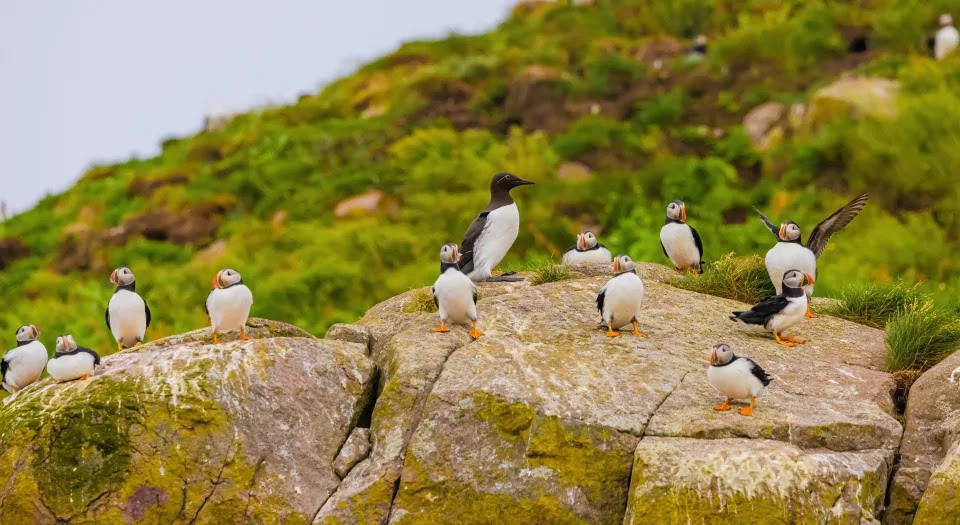
Those fat bears aren't the only ones having fun at explore.org—at any moment, you can watch a nesting bald eagle or guess whether or not that sleeping panda is about to fall out of that tree. There's livestreams of kitten rescue sanctuaries, underwater reefs, puffin loafing ledges (and burrows!), and more. Explore.org runs more than 100 livecams, so there's always somebody fluffy, feathery, or feisty putting on a show.


2. National Park Service
I don't know about you, but if there were a national parks TV channel, I would be watching it 24/7. NPS webcams come close—you can watch everything from the billowing smoke of Hawaii Volcanoes National Park to the dancing kelp off the shores of Channel Islands National Park. At Yellowstone National Park, you can watch the geysers erupt (they even come with timetables, so you know when to break for a snack) or even keep an eye on traffic. The vehicle kind. And the bison kind.


3. Smithsonian's National Zoo
The National Zoo in Washington, D.C., runs about half a dozen livecams at any given time, mostly of the zoo's biggest superstars: pandas, lions, elephants, black-footed ferrets, and—my personal eccentric favorite—the mole rat. They run 24/7, so you might wanna do nighttime checks on your nocturnal or crepuscular pals, like Shaka, Jumbe, Shera, and Amahle, the resident lions.Fun, slightly weird fact: The mole rat can move each of its front teeth separately. (That doesn't sound useful, but it must be!)


4. San Diego Zoo
The San Diego Zoo runs more than a dozen webcams, from 7:30am to 7:30pm, Pacific Time. Most are live, like the koala cam and the polar bear cam, though some are prerecorded, like the panda cam. Check out the burrowing owl cam, which you'd think would be difficult to film—but they've got cams above and below ground for a guaranteed show.

Note: Ever seen a California condor? Maybe not—there are only 500 in the world, mainly due to habitat loss, lead poisoning, poaching, power-line accidents, and DDT. (Prior to conservation efforts, numbers were down to 22.) Susil and Antiki, two adult condors at the San Diego Zoo, hatched a chick in March, and the family fun can be watched via condor cam until the chick fledges in August.


5. Monterey Bay Aquarium
Easily one of the finest aquariums in the nation, Monterey Bay Aquarium has gifted us a slew of webcams, and not just ones underwater. You can watch the playful antics of sea otters, mellow out to the hypnotic drifting of jellies, predict where the crabs will scurry, or address your fears and see how long you can stare at the shark cam. There's even an open sea cam, if you'd like to scope out the goings-on of the California coast.The Monterey Bay Aquarium has gone further with the fun and put it to a soundrack: Krill Waves Radio on YouTube offers hours of lo-fi hip-hop beats set to hours of cleaner shrimp. Hours of squid. Hours of jellyfish. Hours of otters. All floating and relaxing their days away—I think I speak for the lot of us when I say: jealous.


6. Cornell Lab of Ornithology
Birding is hot. Birding is in. (I say this as someone who spends almost as much money on birdseed as groceries.) The Cornell Lab of Ornithology has cams for your standard backyard birds—like the ones who come to the feeder cams, aka woodpeckers, cardinals, and other songbirds—and then they've got cams for species you've probably never seen or heard of before, like rufuous motmots and hellgate ospreys (what a name!). The Panama Fruit Feeders cam is especially vibrant and wild; it's where you can watch toucan TV, proverbially speaking, amongst other colorful flying friends.


7. Georgia Aquarium
At any time, you can peek into the Georgia Aquarium's 6.3-million-gallon tank called the Ocean Voyager (if you're there in person, yes, you'll be on TV). The aquarium also offers us at-home couch potatoes livecam access to puffins, sea lions, jellies, beluga whales, and more incredible creatures roaming their Southern halls.

So, no, you didn't go to the aquarium or the zoo today—you went to both.Jacqueline is a travel, nature, and science writer based in Wisconsin. Follow her work on Yahoo Creators—or find it in the wild at publications like National Geographic, Smithsonian, Travel + Leisure, and more.

Beryl tracker update: Increasing risk of 'life-threatening’ storm surge as path heads toward Texas

Beryl tracker update: Increasing risk of 'life-threatening’ storm surge as path heads toward Texas


Beryl tracker update: Increasing risk of 'life-threatening’ storm surge as path heads toward Texas, After moving through the Caribbean last week, Beryl — currently a tropical storm — is expected to reach Texas this weekend and once again become a hurricane.

As of 7 a.m. central time on Sunday morning, Beryl was about 220 miles southeast of Corpus Christi with maximum sustained winds around 60 mph, according to the National Hurricane Center. The storm is expected to intensify between Sunday and Monday, with Texas Lieutenant Gov. Dan Patrick adding 121 counties to the state's Hurricane Beryl disaster declaration.


Meteorologists warned that “there is an increasing risk of life-threatening storm surge for the Texas Coast.” The storm has been blamed for at least 11 deaths so far.

Tropical Storm Beryl is currently moving through the Gulf of Mexico and is anticipated to strengthen into a Category 1 hurricane as it approaches the Texas coast. Hurricane warnings have been issued for parts of the coast — from the mouth of the Rio Grande northward to San Luis Pass — while a storm surge watch is in place from the mouth of the Rio Grande northward to High Island.

A tropical storm warning was also in effect for the Texas coast south of Baffin Bay to the mouth of the Rio Grande, as well as for the northeastern coast of mainland Mexico from Barra el Mezquital to the mouth of the Rio Grande.


Beryl's damage and impact
Beryl hit Jamaica on Wednesday as a Category 3 storm, causing widespread outages and damage before passing over the Cayman Islands and heading toward Mexico’s Yucatan Peninsula. On July 3, the Jamaica Public Service Company reported that more than 400,000 customers were without power across the country.

Beryl did the most severe damage when it made landfall earlier this week on the Grenadines, a small belt of islands in the eastern Caribbean. About 90% of buildings and homes on three small islands were destroyed or damaged when Beryl made landfall earlier this week, officials said at a news conference held by the Caribbean Disaster Emergency Management Agency.

Jamaica Prime Minister Andrew Holness has declared the country a disaster area until July 10.

Grenada Prime Minister Dickon Mitchell described the "total destruction" to the islands of Carriacou and Petite Martinique in Grenada at a news conference Wednesday.

"Having seen it myself, there is really nothing that can prepare you to see this level of destruction," Mitchell said. "It is almost Armageddon-like, almost total damage and destruction of all buildings, whether they be public buildings, homes or private facilities."

Mitchell also described the "complete devastation and destruction" of agriculture and the natural environment, and severe damage to boats, marinas and the electrical grid on Carriacou.

New images reveal an asteroid that just whizzed by Earth has an unexpected companion

New images reveal an asteroid that just whizzed by Earth has an unexpected companion


New images reveal an asteroid that just whizzed by Earth has an unexpected companion, Astronomers regularly track the trajectories of asteroids to ensure that none of them are on a potential collision course with our planet.

While neither of the recent asteroids whizzed by at a concerning distance, the space rocks can yield valuable information that NASA uses to prepare for any potential future collision scenarios.

Asteroids, which are remnants left over from the formation of the solar system, are also of interest because capturing details about their size, orbit and composition can reveal insights about our corner of the cosmos.


Astronomers at NASA’s Jet Propulsion Laboratory, located in Pasadena, California, used something called planetary radar through the Deep Space Network to track and take images of the asteroids.

The Deep Space Network is a system of radio antennae on Earth that helps the agency communicate with spacecraft exploring our solar system and releases radio waves to act as radar across space.

Spotting a tiny moon
The first space rock, asteroid 2011 UL21, passed by Earth on June 27 at a distance of 4.1 million miles (6.6 million kilometers), or 17 times the distance between Earth and the moon. Researchers first discovered the asteroid in 2011 using the Catalina Sky Survey in Tucson, Arizona. But since the space rock was first spotted, its June flyby of Earth has been the closest it has swung by our planet that radar has imaged.

Astronomers transmitted radio waves from the Goldstone Solar System Radar’s 230-foot-wide (70-meter-wide) satellite dish, near Barstow, California, to the space rock. The waves reflected off the asteroid and traveled back to the network satellite dish’s antenna.

Researchers designated the nearly mile-wide (1.5-kilometer-wide) asteroid as potentially hazardous, which means it has a chance of impacting Earth in the future. But astronomers don’t think it will pose a threat to our planet for the foreseeable future after calculating its future orbits and determining it won’t come too close to Earth.

The radar images showed the asteroid is roughly spherical and is one of a pair, called a binary system. The space rock has a small moonlet orbiting it from a distance of 1.9 miles (3 kilometers).

“It is thought that about two-thirds of asteroids of this size are binary systems, and their discovery is particularly important because we can use measurements of their relative positions to estimate their mutual orbits, masses, and densities, which provide key information about how they may have formed,” said Lance Benner, principal scientist at JPL who led the observations, in a statement.

NASA missions, including the Lucy spacecraft that will explore a mysterious space rock population called the Trojans later this decade, have helped reveal just how many moonlets exist around asteroids in our solar system.

And the DART mission intentionally slammed into a moonlet called Dimorphos, which orbits a larger asteroid called Didymos, to alter the motion of a celestial body in space for the first time as a way to test asteroid deflection technology in 2022.

A space rock surprise
Sometimes, astronomers don’t know an asteroid is on an orbit that carries it close to Earth until just before it makes a near approach. That uncertainty is part of why NASA is ramping up efforts to better understand the population of asteroids that come closest to our world.

The researchers discovered asteroid 2024 MK just 13 days before it flew by Earth, zipping past at a distance of only 184,000 miles (295,000 kilometers) from our planet — just over three-quarters of the distance between Earth and the moon — on June 29.

The Asteroid Terrestrial-impact Last Alert System, or ATLAS, at Sutherland Observing Station in South Africa first spotted the space rock on June 16. While also considered potentially hazardous, the asteroid doesn’t appear to be on a concerning trajectory in relation to Earth anytime soon.

Astronomers sent radio waves to the space rock and captured a detailed image of asteroid 2024 MK. Thirty-foot-wide (10-meter-wide) boulders, as well as concave spots and ridges, litter its surface. The asteroid measures 500 feet (150 meters) wide and appears angular and elongated while also having some prominent flat and rounded areas.

As the space rock passed by our planet and encountered Earth’s gravity, its orbit changed. Now, the asteroid’s 3.3-year trip around the sun has been shortened by about 24 days.

Objects the size of asteroid 2024 MK only come near the Earth every couple of decades, so astronomers collected as much data as they could.

“This was an extraordinary opportunity to investigate the physical properties and obtain detailed images of a near-Earth asteroid,” Benner said.

For more CNN news and newsletters create an account at CNN.com

10 billion passwords have been leaked on a hacker site. Are you at risk?

10 billion passwords have been leaked on a hacker site. Are you at risk?, In the latest cybersecurity scare, a file with nearly 10 billion p...